
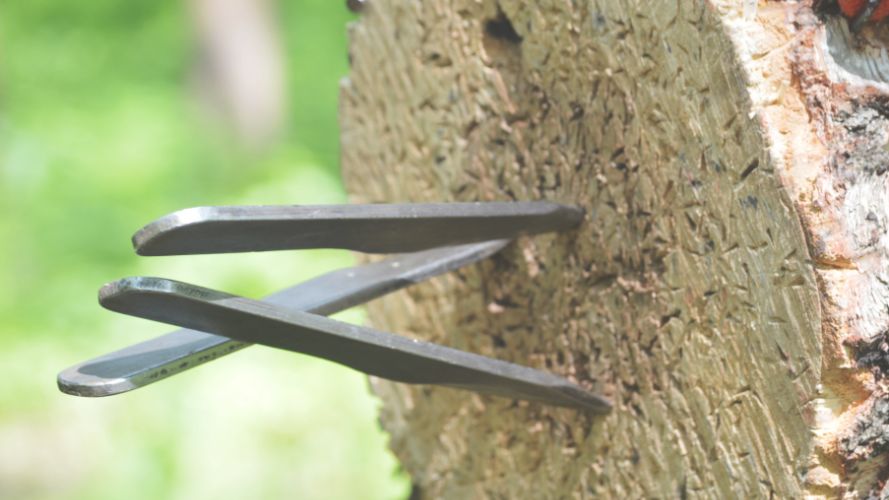
The Difference Between Chinese and Japanese Historical Throwing Knives
A SwordTribe deep dive into two very different traditions of thrown steel.
Thrown blades have a place in the martial history of both China and Japan, but the two traditions grew up separately, for different reasons, with different tools. Lump them together as "throwing knives" and you miss what actually makes each one interesting. Here is how the Chinese and Japanese approaches compare, and why they ended up looking so different.
Chinese Throwing Knives: Escort Agencies and Hidden Weapons
Chinese martial culture groups thrown blades under a much wider umbrella called an qi (暗器), or "hidden weapons" — a category that also includes flexible weapons such as the rope dart and flying claw. Bronze daggers, known as bi shou (匕首), date back to the Zhou dynasty (1046–256 BC) and became standard secondary kit for Han dynasty soldiers, who were required to carry one for close-range fighting.
The dedicated throwing dart, or fei biao (飞镖), is the closest Chinese equivalent to what most people picture as a throwing knife: a compact weapon around 12 centimetres long, shaped anywhere from triangular to needle-like. Its cousin, the fei dao (飞刀) or "flying knife", and the fei jian (飞剑) or "flying dagger", rounded out a family of concealable, hand-thrown blades practised by martial artists rather than issued as standard battlefield equipment.
Popularity rose and fell with the times. Hidden weapons apparently declined during the Song dynasty as more elaborate mechanical devices took their place, only for practice to revive in the early Qing dynasty. Zhang Huaiwu's Xinglong Escort Agency, set up under imperial decree to protect merchants and travellers on the road, became a hub where escorts swapped hidden-weapon techniques. Feibiao practice reportedly peaked from the late Qing dynasty into the early Republican era, making it the most widely practised hidden weapon of its day.
Technique was built around two core throws: a half-spin release and a straight, minimal-rotation throw, chosen according to grip and distance.
Japanese Shuriken: A Samurai's Supplementary Weapon
Japan's thrown blades are better known by their collective name, shuriken (手裏剣) — literally "sword hidden in the hand", built from the characters for hand, release and blade. Shuriken split into two broad families.
Bo-shuriken are straight iron or steel spikes, usually four-sided in cross-section, ranging from roughly 12 to 21 centimetres long. Many were improvised from everyday items such as nails or carpentry tools. The earliest documented use of bo-shuriken comes from the Ganritsu Ryu school, active in the 17th century.
Hira-shuriken are the flat, star-shaped discs most people picture when they hear the word "shuriken", cut from thin sheet metal sourced from coins (hishi-gane), carpentry tools (kugi-nuki) and nail removers (senban).
A persistent myth casts shuriken purely as ninja tools, but the historical record points elsewhere: they were primarily weapons of the samurai, with shurikenjutsu — the art of shuriken throwing — taught alongside swordsmanship at most established schools. The practice traces back to the Warring States period (1467–1603), when escalating feudal conflict drove demand for more specialised combat skills. Crucially, shuriken were rarely a primary weapon; their job was to distract, wound or create an opening that a swordsman could then exploit with the katana.
Where the Two Traditions Diverge
Shape and construction
Chinese feibiao and feidao are knife- or needle-shaped, single-purpose thrown blades. Japanese shuriken split into two distinct forms — the spike-like bo-shuriken and the star-like hira-shuriken — often adapted from repurposed tools rather than purpose-forged weapons.
Role in combat
Chinese hidden weapons were carried by escorts, martial artists and bodyguards as a genuine offensive tool in their own right, particularly on the trade routes protected by escort agencies. Japanese shuriken were overwhelmingly supplementary — a samurai's means of creating a critical half-second of opening before closing with the sword.
Institutional context
Feibiao practice grew up around escort agencies and folk martial arts lineages, tied to the practicalities of protecting cargo and travellers. Shurikenjutsu, by contrast, developed inside formal sword schools (ryu), taught as one part of a broader swordsmanship curriculum rather than a standalone discipline.
Technique
Chinese throwers favoured half-spin and straight-throw releases suited to knife-shaped blades. Bo-shuriken were typically thrown overhand, though sideways and rearward throws are also recorded, reflecting their use for fast, close-range distraction rather than long-range accuracy.
Conclusion
Neither tradition treated the thrown blade as a battlefield mainstay — both were secondary tools, refined in the margins of larger combat systems. But the shape of that refinement reveals a lot about the cultures that produced it: China's hidden weapons emerging from the practical needs of escorts guarding the road, Japan's shuriken sharpened inside the formal, sword-centred world of the ryu. Two very different answers to the same basic idea — that a blade in flight can buy you the moment you need.
Sources
●The Art of Chinese Hidden Weapons: Feidao and Feijian Through History — Medieval Sword School (HEMA) — https://medievalswordschool.co.uk/the-art-of-chinese-hidden-weapons-feidao-and-feijian-through-history/
●Walk into the History of Chinese Throwing — TacticalEdged.Dojo — https://tedojo.com/blogs/walk-into-the-history-of-chinese-throwing
●Chinese Daggers | Bǐ Shǒu | 匕首 — The Splintered Staff — https://splinteredstaff.wordpress.com/2019/06/19/chinese-daggers-bi-shou-%E5%8C%95%E9%A6%96/
●About Hidden Weapons 中国武侠-暗器 — Chinese Moment — https://chinesemoment.com/chinese-culture/about-hidden-weapons-zhong-guo-wu-xia-an-qi
●Eighteen Arms of Wushu — Wikipedia — https://en.wikipedia.org/wiki/Eighteen_Arms_of_Wushu
●Shuriken — Wikipedia — https://en.wikipedia.org/wiki/Shuriken
●The Complete History of the Shuriken: The Ninja Throwing Stars — Knife Depot — https://blog.knife-depot.com/the-complete-history-of-the-shuriken-the-ninja-throwing-stars/
●The Throwing Weapons of the Samurai — Medieval Sword School (HEMA) — https://medievalswordschool.co.uk/the-throwing-weapons-of-the-samurai/
